I Want Fewer RPG Systems

- 3 mins read

The cost of learning a new RPG system is…well just the cost of learning a system. Even for those who like the process, it takes time, and it limits those who can play the game. Ask a regular gaming group of four people to try ‘FISHBLADE: The Diceless RPG’, and chances are high that at least one will veto the suggestion.

The benefit is, of course, a bespoke system.

So when is the cost worth it? I can’t put a number on it, but I can plainly see that the number of systems out there are not really worth the cost of learning the lot.

Minimal Verisimilitude in RPGs

- 3 mins read

I don’t believe in ‘complex’ or ‘simple’ things - those words point to feelings, not facts, so we may as well debate the nature of beauty. But I can count how many steps a system has, and show anyone the result.

RPG systems have a minimum number of steps to retain that nice feeling of realism, and I think that minimum number is ‘4’.

Step 1: Resolution

RPGs can give all manner of results, but at the very least they must show ‘pass/ fail’.

I wanted to make an elemental magic system, and tried to deviate from the four classical elements. It’s a lot more challenging than I thought.

If you go with random stuff, like trees, birds, and rivers as your basic elements, then you end up with a multitude of items.

We could divide the world into larger pieces of course - perhaps ‘small’ vs ‘big’? And have a small-o-mancy wizard?

No - clear nonsense.

Goblin Slayer: The Problem Solver

- 3 mins read

I’ve just clicked what’s good about Goblin Slayer: it scratches the problem-solving itch.

It looks a little like trash. Standard anime, with modern computing techniques for some nice 3D sequences. A fantasy world where the hero kills goblins, along with his companions: Elf, Dwarf, Lizard-Man, and Underage-Priestess. It opens with an extremely distasteful scene of goblin-rape, which feels like the author hitting you over the head with the central premise: ‘goblins bad’.

How I Made BIND's Monsters

- 2 mins read

BIND began as a D&D-reaction. “Mathematically, these rules stand some serious improvement”. After that, I only wanted some generic fantasy monsters to make an example game.

Unfortunately, art costs money, which I didn’t have. The first RPG I’d made lost me a lot of time wandering through cheap stock-art, with a licence stating the buyer can use the image (but of course, not own an actual image for €3.75). Every one showed a plethora of weird creatures some artist had made for an existing campaign, or some cobble-together creature. One collection had a couple of weird octopus-creatures, another a smooth-skinned giant humanoid with an orb for a head.

Writing for the GM

- 3 mins read

I don’t have the reading time for RPGs I once did (or for anything). I’d like to chalk if up to being an adult with a job now, but perhaps the truth is just ‘internet’.

Whatever the reason, I want to write better for GMs. Here are the principles I’ve picked up from reading/ writing (no credits given - I can’t even remember which ideas are mine, and which I found, never mind where I found them).

(a story about spreadsheet failure)

I’ve considered changing BIND’s ’to-hit’ system to let players ‘go for the eyes’ (or a headshot, or otherwise decide to attempt a vitals shot), and decided against it. My reasons sit below, but expect lots of boring numbers. You have been warned. (or just skip to the conclusions)

Quick Recap

Consider someone with a shortsword with +2 Strength - they deal 1D6 + 2 Damage, or 5.5 on average (this could also be 1D8 +1 or whatever). Let’s also assume that the opponent has the same stats, making the Tie Number (TN) ‘7’.

New Handouts

- 2 mins read

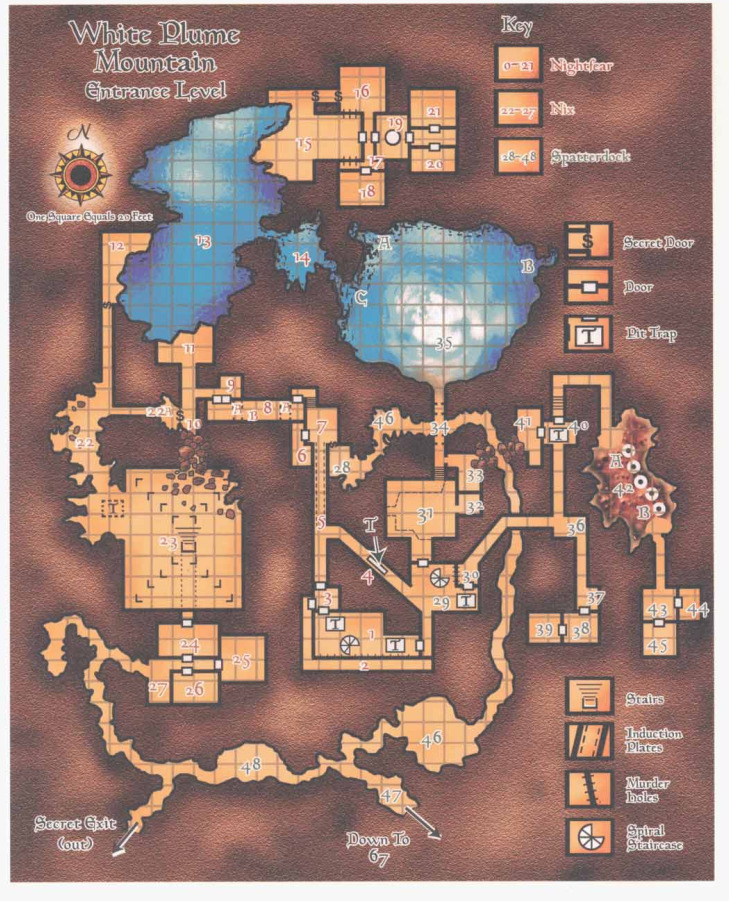
BIND’s maps have their numbers and comments applied by its writing tool, LaTeX. This makes handouts really easy, because the same map can present different layers to different people.

Here’s the plan so far (it’s untested, none of my players have seen this):

The fallen temple to Eldren (god of death and pensions) has an alternative from when it was still standing (both maps made by Dyson Logos).

Temple Map

This means that if the PCs research at the local library, they can find a map of the original:

Sleeping in a Dungeon

- 1 min read

The A,D&D core book stated that wizards could only memorize spells in the morning, and also only after eight hours of complete rest. The bigger dungeons occasionally demanded that people sleep in the dungeon in some safe corner.

These two aspects never sat well with me. I kept picturing the party’s fighter lecturing some poor mage:

Rest well! Don’t worry about the monsters, or worry about nightmares. We’re gonna need your spells in the morning, so have sweet dreams, or we’re going to be down a party member, and we need everyone we can get. We’re off soon, so don’t spend too long getting to sleep. If you don’t fall sleep now, no spells, and you’ll end up being eaten by some monster without that wizard-shield, and likely the rest of us will too without your fireball spell.

Dungeons Need More Space

- 3 mins read

The dungeon ecosystem doesn’t make a whole lot of sense, but I think Tolkien has a fix.

Wandering Monsters Don’t Make Sense

I love the formula. In the cold depths, something approaches, and it wants to eat you.

Deep underground, you tread carefully, then stop as you hear heavy footsteps. Or perhaps those aren’t feet?

Add this to an existing dungeon, and elements quickly tie together. Perhaps player lure the monster into that death-gaze statue. Or perhaps they flee from a giant umberhulk, and stop just before a pit-trap and have to think quickly!